
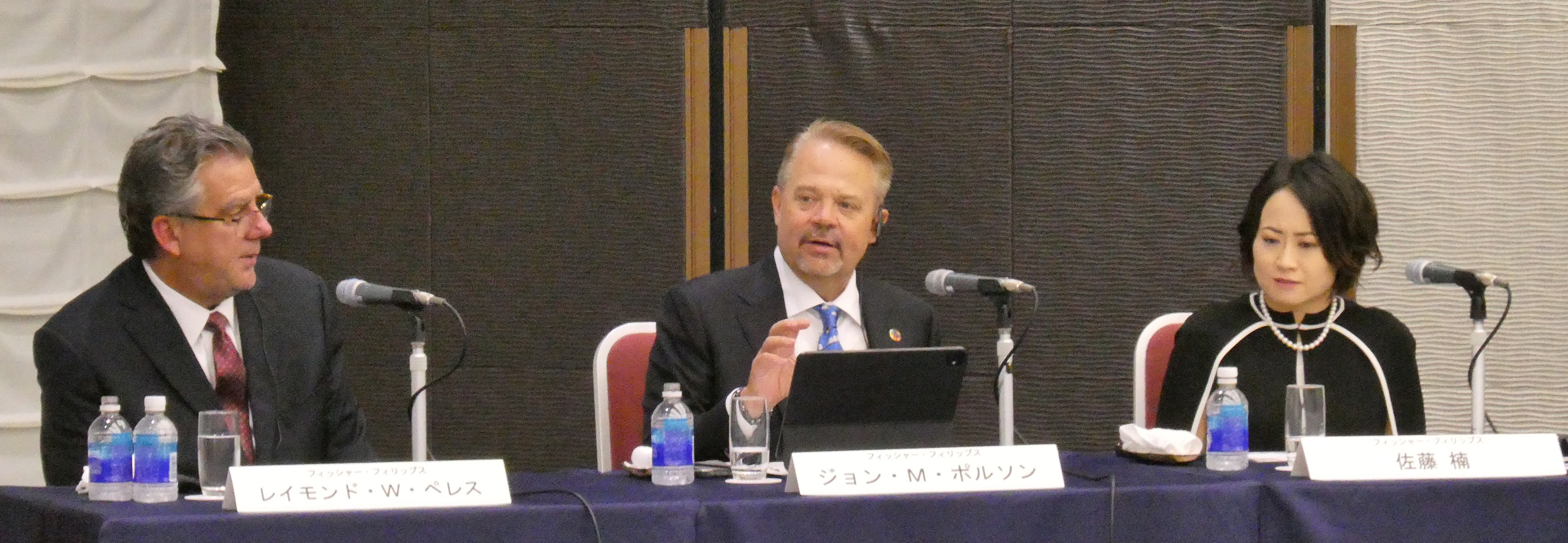
Seminar Beyond Tariffs: Practical Strategies to Elevate Your Investment in the U.S. John Polson, Fisher Phillips, LLP
October 14, 2025
Tokyo
Keizai Koho Center (KKC) held a meeting with a major U.S. law firm, Fisher Phillips, LLP, attended by approximately 40 people, including executives in charge of overseas operations and external affairs. Fisher Phillips, LLP, which specializes in labor and employment law, has supported the business activities of both Japanese and American companies. Chairman and Managing Partner Mr. John Polson, together with other attorneys from the law firm, provided an overview of the reciprocal tariffs imposed by the Trump administration and their impact on Japanese enterprises. They also outlined the economic incentives available at the federal, state, and local levels, which relate to successful investments. The meeting concluded with a lively exchange of views between the participants and the firm’s representatives.
Trump’s Tariffs and Their Impact on Japanese Companies U.S. tariff measures have led to increased overseas corporate expansion and investment into the United States, creating precisely the favorable conditions intended by U.S. policymakers. At the same time, however, some caution that these measures may contribute to inflationary pressures. In the labor market, labor shortages are becoming more acute due to the impact of immigration policies and other factors, thereby heightening uncertainty. The current administration is pursuing an unconventional negotiation process, leaving companies in a disadvantageous position where they must negotiate only after radical policy decisions have been made. For Japanese firms considering investment or expansion in the U.S., success will depend on a thorough understanding of the evolving environment, the selection of capable negotiators, and a calm and patient approach.
Strategies for Successful U.S. Investment A range of economic incentives is available to businesses, including federal programs, state statutory provisions, and state and local discretionary measures. These incentives have increased year by year, reflecting the growth of the U.S. economy. To advance investment projects under more favorable conditions, it is essential for companies to take necessary steps such as assembling a team that includes legal advisors, setting timelines, and identifying candidate sites. Companies must define their core and desired requirements, enforce rigorous information management, and conduct on-site inspections of potential locations and their surrounding areas. Prior investigation into site conditions, infrastructure, labor availability, living environment, and the presence of labor unions is critical. In the U.S., workers frequently change jobs in pursuit of better compensation, meaning that inadequate management of salaries and working conditions can undermine retention. Ultimately, selecting the optimal site requires meticulous preparation combined with strong negotiation skills.
Beware of the Relationship between Federal and State Laws In the Japan-U.S. tariff negotiations, an agreement was reached providing for $550 billion of U.S. investment over a three-year period. However, the specific methods and incentives under this commitment remain unclear, and it is likely that few in the United States are fully aware of the details at this stage. Particular attention must be given to the relationship between federal and state laws. Even if incentives are introduced at the federal level, the presence of state laws means there is no guarantee that they will be applied smoothly or uniformly.